How to Optimize Your Blog Structure for AI Overviews
- Sarah Crowe
- August 6, 2026
- 898 Marketing, SEO
- 0 Comments
If you’ve noticed an AI-generated summary box showing up above your usual search results, you’re not imagining it. AI Overviews are now a fixture in search, and they’re changing how people find (and never have to click through to) content. For businesses that rely on their blog to drive traffic, that shift raises an obvious question: How do you optimize for AI overviews when the “result” isn’t even a webpage anymore?
The good news is that AI Overviews aren’t a mysterious black box. They pull from content that’s already well-structured, clearly written, and easy for a language model to extract and summarize. In other words, the same fundamentals that make a blog post good for readers also make it good for AI. This post walks through how to optimize content for AI Overviews by rethinking the way you structure your blog posts, from headers to schema markup.
What Is an AI Overview, and Why Should You Care?
An AI Overview is the AI-generated summary search engines like Google place at the top of search results, synthesizing information from multiple sources into a direct answer. Instead of scrolling through ten blue links, searchers get a concise answer immediately, often with a few cited sources underneath.
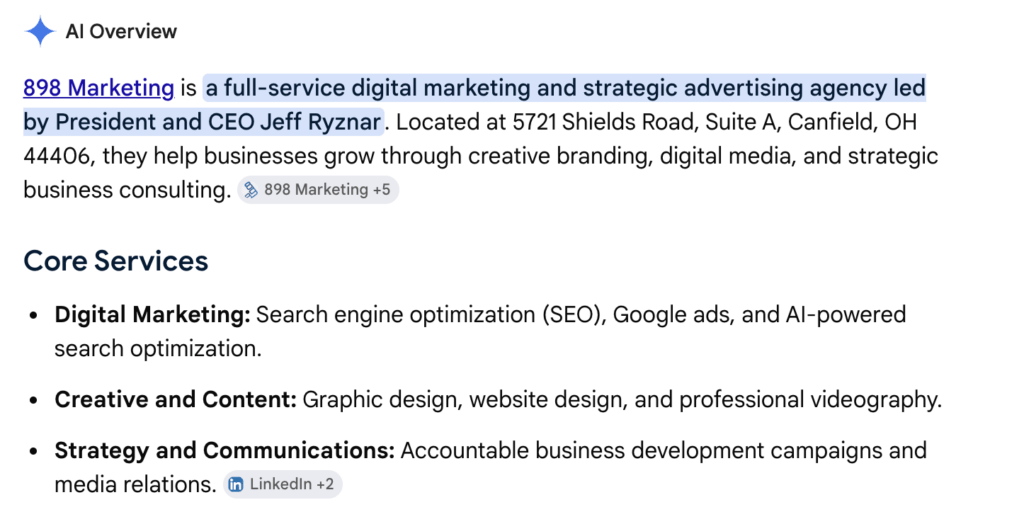
For businesses, this changes the game in two ways.
- First, it means less overall click-through traffic for informational queries, since many searchers get their answer without visiting a site at all.
- Second, and more importantly, it means visibility now depends less on ranking #1 in traditional results and more on whether your content is structured in a way that’s easy for AI to pull from and cite.
Understanding this shift is the first step in how AI is changing SEO more broadly, and it’s reshaping how we think about content strategy across every industry we work with.
How to Rank in AI Overviews: Structure Matters More Than Ever
If you’re wondering how to rank in AI Overviews, the answer isn’t a secret trick — it’s a disciplined structure. AI systems scan content looking for clear, well-organized information they can lift and reformat into a concise answer. Blog posts that ramble, bury the point, or lack clear organization are much harder to extract from than posts built with AI in mind.
Here’s how to structure your blog content so it’s primed for both search engines and AI overview optimization.
1. Lead With the Answer
Every blog post (and ideally every section within it) should answer the reader’s question as directly as possible, right up front. If someone searches “what is an AI overview,” don’t make them wait three paragraphs for a definition. Give it to them in the first sentence, then expand with context and nuance afterward. This inverted-pyramid style is exactly how AI models extract information: they’re looking for a clean, standalone answer they can quote or paraphrase.
2. Use Descriptive, Question-Based Headers
Headers do double duty in AEO (answer engine optimization): they organize content for human readers and they act as signposts for AI crawlers scanning for relevant sections.
Where it makes sense, phrase your H2s and H3s as the actual questions people are searching, “How to optimize for AI overviews,” “What does AI overview mean for SEO,” rather than vague labels like “Overview” or “Background.” This mirrors natural language queries and makes it far easier for an AI system to match your section to a searcher’s intent.
3. Build in a Mini-FAQ Section
FAQ sections are one of the most reliable ways to earn a spot in an AI Overview because they’re already formatted the way AI likes to consume information: short, direct, self-contained question-and-answer pairs. Even a compact FAQ of three or four questions near the end of a post can significantly improve your odds of being cited. Pair this with FAQPage schema markup (more on that below) to reinforce the structure programmatically.
4. Break Up Dense Paragraphs
Long, unbroken paragraphs are harder for both readers and AI models to parse. Aim for short paragraphs, bulleted lists where appropriate and bolded key terms that make the important takeaways scannable at a glance. Think of your post as something that needs to work whether it’s read top to bottom by a human or scanned in fragments by a machine.
5. Add Structured Data (Schema Markup)
Schema markup gives search engines and AI systems explicit signals about what your content is and how it’s organized. For blog content, that typically means Article or BlogPosting schema at minimum, layered with FAQPage schema if you’ve included an FAQ section. This structured data doesn’t guarantee an AI Overview placement, but it removes ambiguity about your content’s structure, which makes it easier for AI to extract cleanly.
A Quick Checklist for Optimizing Content for AI Overviews
When you sit down to optimize a blog post (new or existing) for AI Overviews, run through this list:
- Does the first paragraph directly answer the core question?
- Are your headers phrased as natural-language questions?
- Is there a clear, concise FAQ section near the end?
- Are paragraphs short and scannable, with bolded key terms?
- Does the post include relevant schema markup?
- Are claims backed by specifics (numbers, examples, named tools) rather than vague generalities? AI Overviews tend to favor content with concrete, citable details.
This isn’t a one-and-done exercise. AI Overview results shift constantly as the underlying models change, so treating this as an ongoing part of your content strategy, rather than a single audit, will serve you better long term.
Understanding the AI Overview Shift for the Long Haul

It’s worth remembering that AI Overviews are one piece of a much larger shift happening in search and marketing right now. AI is reshaping everything from how content gets discovered to how customers make purchasing decisions, and blog structure is just one lever among many.
If you haven’t already, it’s worth looking at the broader marketing trends businesses should be paying attention to in 2026 to see how AI overview optimization fits into your bigger picture strategy.
Frequently Asked Questions about AI Overview’s
How do I optimize content for AI overviews?
Lead with a direct answer, use question-based headers, add a short FAQ section, keep paragraphs scannable, and add relevant schema markup so search engines can clearly parse your content’s structure.
Will AI overviews replace traditional SEO?
No. AI Overviews are built on top of the same signals traditional SEO relies on, relevance, authority, clarity, and structure. Strong SEO fundamentals remain the foundation; AEO best practices simply layer on top.
Does schema markup guarantee I’ll appear in an AI overview?
No single tactic guarantees placement. Schema markup improves the odds by making your content’s structure explicit, but it works alongside content quality, relevance, and authority signals.
Where This Fits Into Your Overall Content Strategy
Optimizing for AI Overviews isn’t a separate discipline bolted onto your existing SEO efforts, it’s an extension of good content development and search engine optimization practice. The businesses that will keep showing up in search, whether as a traditional result or an AI-generated summary, are the ones producing clear, well-organized, genuinely useful content.
If you want a closer look at how AI is reshaping search and what that means for your business specifically, our AI Pulse Report is a good next stop.
Related Posts





Recent Comments